
Sewing Machine Feet Explained: A Beginner's Guide to 7 Essential Feet
May 27, 2025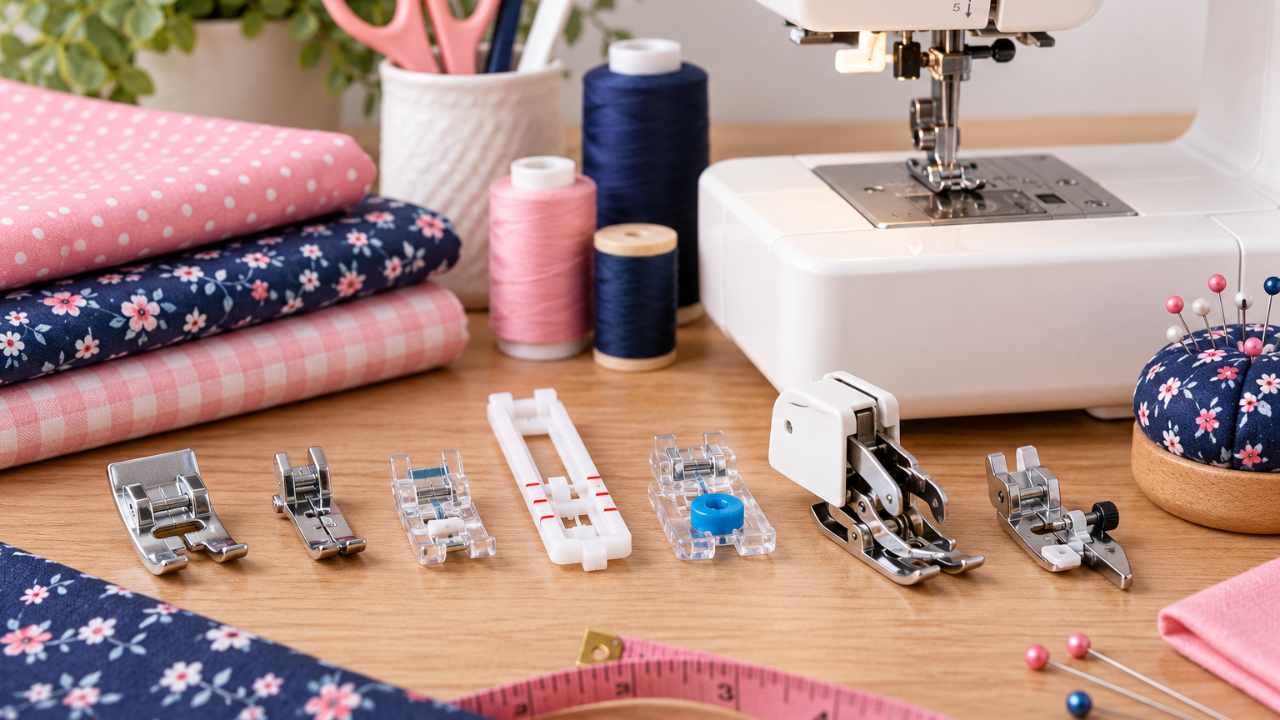
Ever opened the little accessories box that came with your sewing machine and wondered what on earth all those strange-looking bits of metal are for?
You're definitely not alone!
When you buy your first sewing machine, you'll usually find a selection of sewing machine feet tucked away somewhere. Some look fairly straightforward, while others look like they belong in a toolbox rather than a sewing room!
And if you're anything like most of us, you'll probably pop them safely back in their little compartment, close the lid and carry on using the same foot for absolutely everything.
Sound familiar? 😂
Well, those little feet are actually rather clever. Each one is designed to make a particular sewing job easier, neater or quicker.
From inserting zips to sewing buttonholes and tackling tricky fabrics, using the right sewing machine foot can make a huge difference to your finished projects.
So, let's take a look at some of the most useful sewing machine feet, what they do and when you might want to use them.
First Things First – Will Any Sewing Machine Foot Fit My Machine?
Before you rush off to buy every sewing machine foot you can find (we know how tempting sewing accessories can be!), there's something important to remember.
Not all sewing machine feet fit all sewing machines.
Different manufacturers and models use different fittings, so it's always worth checking compatibility before buying.
We recommend purchasing feet designed for your particular sewing machine, ideally from the manufacturer or a reputable sewing machine specialist.
Your local sewing machine shop can be a brilliant source of advice, especially if you're unsure which foot you need. (we recommend Hobkirks whom you can visit in person or online)
And don't forget your sewing machine manual! It might not be the most exciting bedtime reading, but it's full of useful information about which feet to use and how to set up your machine.
Stitchi Tip: You don't need dozens of different sewing machine feet to create beautiful projects. Start by getting comfortable with the ones you already have, then add to your collection as your sewing skills develop.
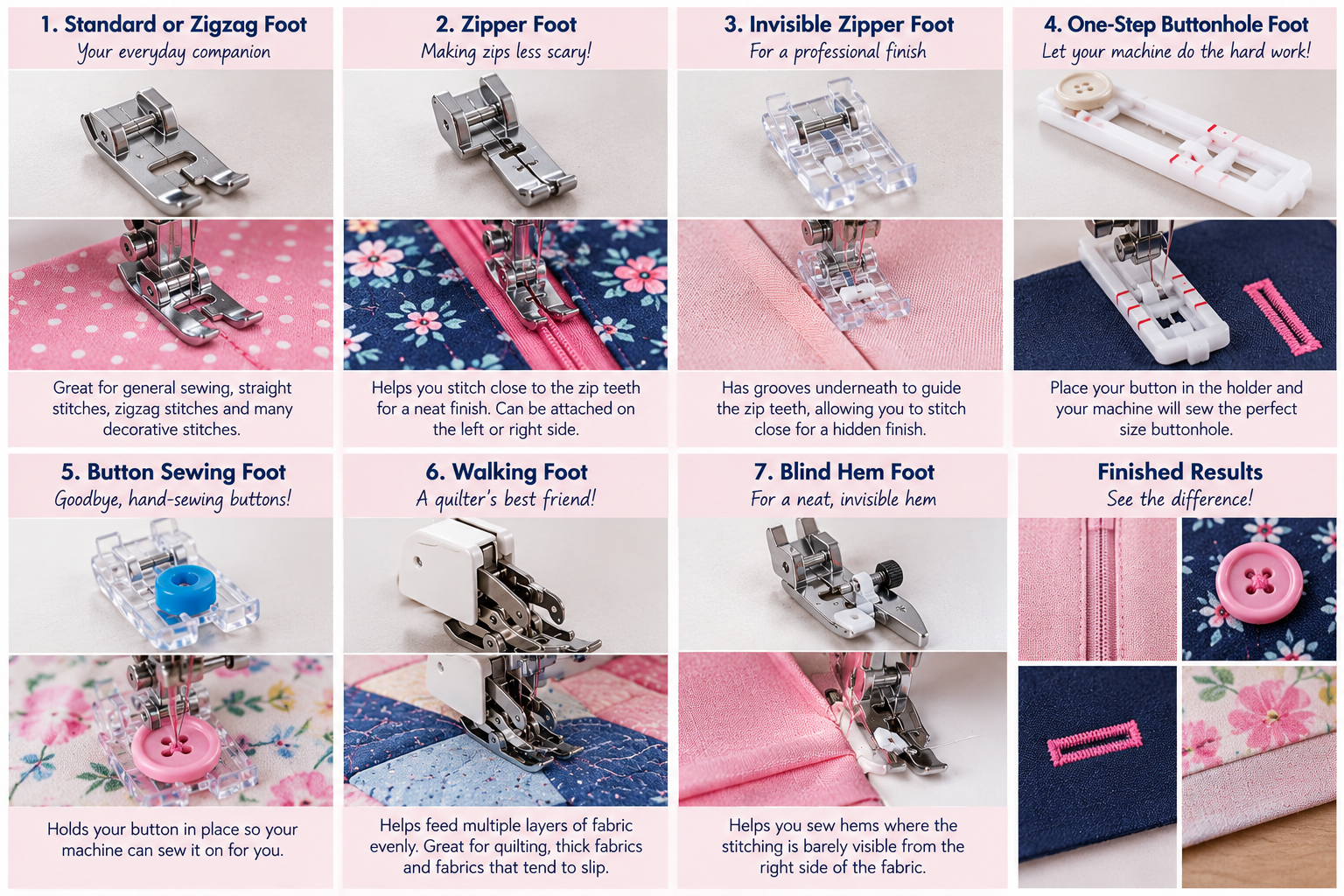
1. Standard or Zigzag Foot – Your Trusty Everyday Companion
If sewing machine feet had a popularity contest, this one would win hands down!
The standard foot (sometimes called the zigzag foot or all-purpose foot) is the one you'll probably use for most of your sewing projects.
It's the reliable, hardworking member of the sewing machine foot family.
This foot is suitable for lots of everyday sewing tasks, including:
-
Straight stitching
-
Zigzag stitching
-
Basic decorative stitches
-
Satin stitches
-
Many overcasting stitches
For beginners, this is usually the foot you'll become most familiar with.
It's perfect for sewing seams, putting together bags, making cushions and tackling all sorts of lovely projects.
However, if you're working with particularly slippery fabrics such as silk or chiffon, you might find that a more specialised foot makes life easier.
Stitchi Tip: If you're just starting out, spend some time getting comfortable with your standard foot. You'll be amazed at how much you can create with this one little attachment!
2. Zipper Foot – Making Zips Less Scary!
Ah, zips.
For some reason, the very mention of inserting a zip can send a nervous beginner running for the hills!
But here's a little secret...
Zips really aren't as frightening as they look, especially when you've got the right foot.
Most sewing machines come with a basic zipper foot.
Unlike your standard foot, a zipper foot is designed to let you stitch close to the teeth of a zip without the foot getting in the way.
Many basic zipper feet can be attached on either the left or right side, depending on which side of the zip you're sewing.
This allows you to get nice and close to the zip teeth for a neat finish.
Some machines also allow you to adjust the needle position for even greater accuracy.
When would you use it?
A zipper foot is particularly useful for:
-
Zipped pouches
-
Bags with zip closures
-
Cushion covers
-
Clothing
-
Other projects where you need to stitch close to a raised edge
Stitchi Tip: Don't rush when inserting a zip. Take your time, keep your stitching nice and steady, and remember to stop with the needle down before lifting your foot to adjust the fabric.
And if your first zip isn't quite perfect? Welcome to the club! We've all been there.
3. Invisible Zipper Foot – The Clever Little Disappearing Act!
Have you ever looked at a beautifully made dress or cushion and wondered where the zip has gone?
Chances are, it's an invisible zip!
An invisible zip is designed so that the teeth are hidden within the seam, giving your project a lovely, professional finish.
And there's a special foot to help you achieve it.
An invisible zipper foot has small grooves underneath that guide the zip teeth as you sew.
This allows you to stitch very close to the teeth so that the zip almost disappears when closed.
Clever, isn't it?
When would you use it?
Invisible zipper feet are particularly useful for:
-
Dresses
-
Skirts
-
Smart cushion covers
-
Projects where you want the zip to be hidden
Stitchi Tip: Be careful not to stitch too close to the zip teeth, or you might find that your beautifully inserted zip refuses to open or close!
And there's nothing quite as frustrating as finishing a perfect zip only to discover you've sewn it shut. 😂
4. One-Step Buttonhole Foot – Let Your Machine Do the Hard Work!
If you've ever tried sewing a buttonhole by hand, you'll appreciate just how clever this little foot is.
Many modern sewing machines come with a one-step buttonhole foot, although some machines use a four-step system instead.
With a one-step buttonhole foot, you simply place your button into the adjustable holder at the back of the foot.
Your machine uses this to determine the appropriate size of buttonhole.
Once you've selected the correct settings, the machine takes care of sewing the buttonhole for you.
No measuring each side individually and hoping they match!
When would you use it?
Buttonholes are useful for:
-
Shirts and blouses
-
Dresses
-
Cushion covers
-
Bags with button fastenings
-
Home décor projects
Stitchi Tip: Always practise your buttonhole on a scrap of the same fabric first, using the same number of layers and interfacing as your actual project.
It's much better to discover that your settings need adjusting on a scrap than on the front of something you've spent hours making!
5. Button Sewing Foot – Goodbye, Hand-Sewing Buttons!
Did you know that many sewing machines can actually sew buttons on for you?
Yes, really!
If you've been sitting there sewing buttons on by hand, you might be wondering why nobody mentioned this sooner.
A button sewing foot holds your button securely in place while your machine stitches through the holes.
You'll need to set your machine to the appropriate zigzag stitch and adjust the stitch width to match the distance between the holes.
It's important to make sure the needle lines up correctly with the holes before you start sewing.
Some machines also come with a small spacer that helps create a thread shank, giving the button a little extra room when fastening thicker fabrics.
This is particularly useful for coats and jackets.
When would you use it?
-
Shirts
-
Blouses
-
Jackets
-
Coats
-
Decorative buttons on bags and accessories
Stitchi Tip: Always turn the handwheel towards you for a few stitches before using the foot controller. This lets you check that the needle passes cleanly through the buttonholes without hitting the button.
Nobody wants a broken needle flying across the sewing room!
6. Walking Foot – A Quilter's Best Friend!
Now, this is one sewing machine foot that really deserves a round of applause.
If you've ever tried sewing several layers of fabric together and found that they seem to have developed minds of their own, a walking foot might be just what you need.
A walking foot helps feed the top layers of fabric through your sewing machine at a similar rate to the bottom layers.
Normally, your machine uses little metal teeth underneath the fabric, called feed dogs, to move everything along.
But when you're sewing several layers together, the top fabric can sometimes move differently from the bottom.
The result?
Fabric that shifts, stretches or refuses to line up where it's supposed to.
Very annoying!
A walking foot adds an upper feeding action to help keep everything moving more evenly.
When would you use it?
Walking feet are brilliant for:
-
Quilting
-
Patchwork projects
-
Sewing multiple layers of fabric
-
Working with wadding
-
Some stretchy fabrics, including jersey
-
Projects where fabrics tend to slip or shift
They're particularly useful when quilting through a quilt sandwich made up of your quilt top, wadding and backing fabric.
Stitchi Tip: A walking foot can make a real difference when sewing thicker projects, but remember to check your machine's instructions for fitting and using it correctly.
Some walking feet have a little arm that sits over the needle clamp screw, while others use a different attachment system.
And if you're wondering whether you really need one, we'd say it's certainly worth considering if you enjoy making quilts, bags or projects involving several layers.
7. Blind Hem Foot – For When You Don't Fancy Hand-Sewing!
Hands up if you love hand-sewing hems.
Anyone?
No?
We thought so! 😂
If you'd rather let your sewing machine do the work, a blind hem foot can be a very useful addition to your collection.
It's designed to help you sew hems where the stitching is barely visible from the right side of your fabric.
Perfect when you want a neat, professional finish without spending your evening hand-stitching.
How does it work?
The blind hem foot has a guide that helps you position the folded fabric correctly.
You fold your hem in a particular way, then select the blind hem stitch on your sewing machine.
As you sew, the needle catches just a tiny amount of the garment fabric.
When you unfold the hem, only small stitches should be visible on the right side.
The trick is getting the fabric fold and needle position just right.
When would you use it?
Blind hem feet are particularly useful for:
-
Trousers
-
Skirts
-
Dresses
-
Curtains
-
Other projects where you want a discreet hem
Stitchi Tip: Practise on some scrap fabric first, and don't worry if it takes a few attempts to get the fold and stitch position right.
Blind hems are often less noticeable on patterned or textured fabrics, making them a good place to start.
So, Do You Really Need All These Sewing Machine Feet?
The short answer?
No! But knowing what they do can make your sewing life so much easier.
If you're new to sewing, don't feel that you need to rush out and buy every foot available.
Your standard foot and zipper foot will take you a surprisingly long way.
As you start experimenting with different projects, you'll naturally discover which additional feet would be useful.
If you enjoy quilting, a walking foot might become your new best friend.
If you're making clothes, you might find yourself reaching for your buttonhole or invisible zipper foot more often.
And if you love making bags and accessories, learning how to use your zipper foot confidently is a brilliant skill to develop.
The most important thing is to enjoy learning and not be afraid to try something new.
After all, those mysterious little sewing machine feet aren't going to do much sitting in the bottom of your accessories box!
Want to Get More Confident With Your Sewing Machine?
At Stitchi Sewing Club, we're all about making sewing enjoyable, achievable and a lot less intimidating.
With over 300 step-by-step video tutorials, two new projects every month and a friendly team of real sewing tutors ready to help, you'll never be short of inspiration or support.
Whether you're learning how to insert your very first zip or you're ready to tackle something more adventurous, we're here to help you every step of the way.
And the best bit? You can learn at your own pace, from the comfort of your own sewing room.
Why not give Stitchi Sewing Club a try with our FREE 7-day trial?
👉 Discover Stitchi Sewing Club and Start Your Free Trial
Happy sewing!
Andrea & the Stitchi Team xx
